Trees on Development Sites
Trees are a material consideration in the UK planning system. Therefore, existing trees are an important factor on any construction site, whether within the proposed development site or adjacent to it. Rowbottom’s Tree Services Ltd is able to provide BS5837:2012 compliant tree reports with AutoCad plans, to suit small domestic planning applications for house extensions or major site tree reports for large developers.
A BS 5837:2012 tree survey and report may involve three elements, depending on the size of the project :-
A Tree Constraints Plan: A pre-development survey of the site trees in accordance with BS5837:2012, to assess the condition of the existing site trees and categorise them for retention potential. The information provided by the Tree Constraints Plan is used to identify potential development windows on the site. Such information is often required by many Local Planning Authorities prior to submitting a site design.
Arboricultural Impact Assessment (AIA): The AIA would specify which trees are likely be affected by the proposed design. To identify trees that require removal, trees that can be easily retained and protected and trees that may require special forms of protection or the application of special building / engineering techniques.
Arboricultural Method Statement (AMS): Following a pre-development survey and / or AIA, an Arboricultural Method Statement would set out the processes required to protect the retained site trees from the development process. It may specify tree pruning works required to facilitate the development, type and location of protective fencing and special engineering techniques required should the development have to enter a tree Root Protection Area (RPA) etc. The Arboricultural Method Statement often forms part of a planning condition.
It can be possible to build near to mature trees. Please contact us should you require more information.
Home Buyers and Insurance Tree Reports
Home Buyers and Insurance Tree Reports are preliminary tree reports produced to assess the risk of indirect damage to properties due to tree root activity on shrinkable clay soils. They also take into account inappropriately sited trees adjacent to properties and landscape structures.
Tree Risk Assessment Surveys & Reports
Trees provide many benefits to people living and working in the urban environment. Such benefits increase as the trees become larger. However, as they get older and larger, trees may become more likely to shed branches or develop decay which can lead to an increased likelihood of failure. Also the consequences of tree or branch failure become greater with size and age. It is impossible to maintain trees free from all risk. Some level of risk must be accepted to experience the benefits provided by trees. Tree owners and managers have a duty of care to users of their sites and facilities. This duty of care, however, need only be reasonable and proportionate to the specific conditions and situations. Rowbottom’s Tree Services Ltd can provide tree risk assessment reports using various recognised methods: Quantified Tree Risk Assessment (QTRA) and ISA Tree Risk Assessment Qualification (TRAQ). The Tree Risk Assessments can be tailored to assess the risk posed by one tree or multiple trees on a site.
Trees & The Law, Advice
Rowbottom’s Tree Services Ltd can assist with tree related issues that involve:-
Tree Preservation Orders (TPO): TPO applications, TPO appeals, TPO objections etc., or a client’s concerns regarding a planning application close to their trees.
Conservation Areas: Not the same as TPOs, but similar. Contraventions can still result in penalties analogous to a TPO contravention.
Forestry Commission Felling Licences; An area of tree law less well known. Compliance with such a licence is required when felling certain quantities of live timber unless specific exemptions apply.
Airspade Service: To Maintain or Improve Tree Health
Trench excavation within tree root zones
Occasionally, due to limited available space it may be necessary to install drains and other underground utilities within a tree root zone. Conventional excavation trenching using a mechanical digger is likely to cause irreparable damage to tree roots, such damage becoming more serious the closer the trench is to the tree. Airspade trench excavation loosens and displaces the soil from around the tree roots, leaving the roots intact and allowing utility piping to be laid underneath them.
Soil de-compaction and aeration
Stunted growth and sometimes decline of urban trees is often associated with poor soil conditions, the most common of which is compaction of the soil structure. Airspade soil aeration injects air into the upper soil layers which fractures the compacted soil to form a more desirable crumb structure. During this process, soil nutrients and conditioners (e.g. biochar) can be incorporated into the soil.
Over millions of years trees have evolved to grow in large groups within forests, apart from a few pioneer trees (e.g. birch, poplar aspen etc.) which, with their light wind borne seeds, have evolved to exploit and colonise open ground. The very nature of forest conditions produces perfect soil structure and nutrient recycling required for optimum tree growth. As it is generally held as advantageous that trees grow and thrive as small groups or individuals, even within our hostile urban environments, then, we should attempt to mimic as close as possible the natural soil conditions that trees require. Airspade soil de-compaction and vertical mulching provides a practical way of achieving this for urban trees.
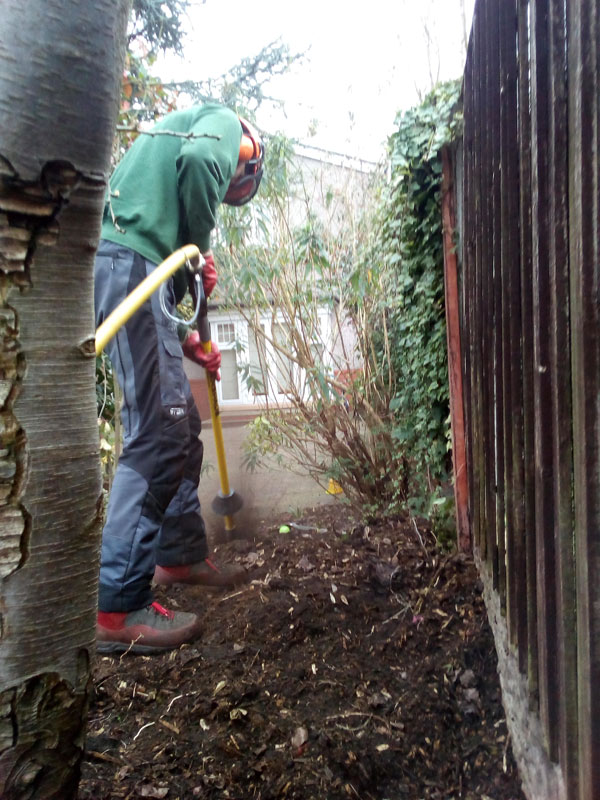
Soil de-compaction & vertical mulching among fruit trees in a private garden